
热门搜索: 假如爱有天意
我的女孩
高清大画面!玉兔2号和嫦娥4号正在互相拍照。_我的网站

A |
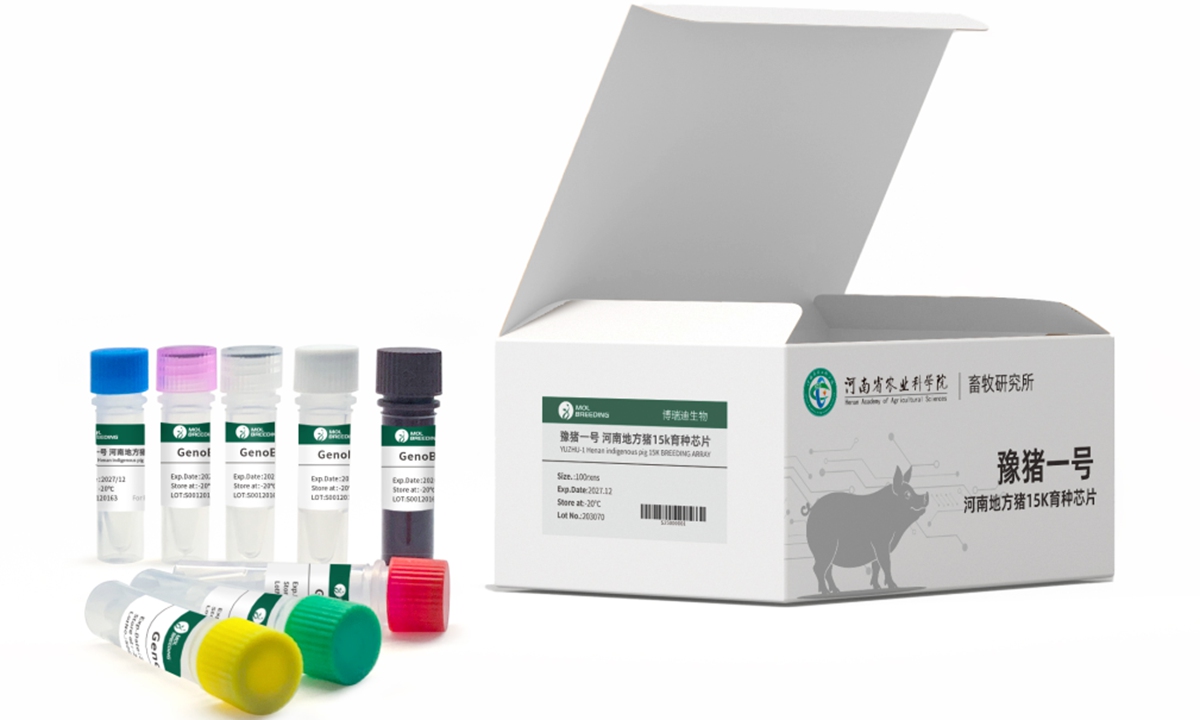
China's largest pork-producing province has introduced a genomic breeding tool designed for indigenous pig breeding, a sign that the province is shifting from expanding volume toward improving hog quality.
The Henan Academy of Agricultural Sciences announced the launch of Yuzhu-1 Henan indigenous pig 15k breeding array - commonly known as a gene chip - developed by the pig breeding team at its Institute of Animal Husbandry and Veterinary Science. It is the first such tool customized for the province's native pig stock, the institute said on Monday.
Henan is home to multiple native pig breeds prized by consumers for their good flavor. However, they carry a commercial burden compared with imported lean-meat breeds, as they grow more slowly, consume more feed per kilogram of weight gain and deliver thinner margins, noted Xing Baosong, head of the pig research office at the institute.
Lifting those hurdles depends on sharper selection, which in local herds has long relied on visual assessment of physical traits, which is slow and imprecise. Genomic tools can speed things up, but mainstream commercial chips were built on imported breeds and lose accuracy on native Chinese stock. Yuzhu No 1 instead draws on whole-genome resequencing data from five of Henan's native pig breeds and two locally bred lines.
"In breeding we rely on estimated breeding values to judge an animal's genetic potential," Wang Ligang, a professor at the Institute of Animal Sciences under the Chinese Academy of Agricultural Sciences, told the Global Times on Monday. "An array matched to the breed makes that estimate more accurate. Previously there was a real chance we were selecting the wrong animals. Now we are far more likely to be selecting the right ones - and to select accurately for the traits a breed is known for, whether that is tender meat or high fertility."
The efficiency gap between native and imported pig breeds remains wide, said Wang, who is also with the Pig Branch of the Chinese Association of Animal Science and Veterinary Medicine. Feed conversion ratios for local Chinese pigs run around 3.0, against below 2.5 for imported breeds, while reaching 100 kilograms takes native pigs 180 to 190 days compared with 130 to 140 days for exotic lines, he said.
Despite this, China's native pig breeds have their advantages.
"Our pigs taste better, partly because they are raised longer," Wang said. "And they are far more robust. Exotic breeds can suffer heat stress and die in summer; when disease hits, they can go down in large numbers. Local pigs rarely do. They tend to recover. Some breeds in Northeast China can even tolerate severe cold."
He added that imported breeds drive efficiency, while native breeds ensure quality and offer a reservoir of genetic diversity for disease and stress resistance - traits that can be bred back into commercial lines.
The province slaughtered 64.74 million pigs in 2025, up 7.4 percent year on year, with pork output at 5.22 million tons, according to the provincial statistics bureau, making it the top pork and pig producer nationwide, according to industry statistics.
In the first half of 2026, pig slaughter in the province rose a further 6.4 percent, accelerating 5.3 percentage points from the first quarter, against national growth of 1.7 percent. Xing said that more high-quality local black pigs will reach the market as Yuzhu No 1 is applied more broadly.
Other major pig production provinces such as Southwest China's Sichuan, Northwest China's Shaanxi and South China's Yunnan have all developed their own arrays.
"Provinces with the most developed pig production are the ones pushing upmarket," Wang said. "Scale is no longer the only measure. If every province reaches this level, a pattern of one dedicated array per province could gradually take shape for China's native breeds."
。据美国航天局介绍,1月11日下午,嫦娥四号登陆器和玉兔二号巡逻队工作正常。在喜鹊桥中继卫星的支持下,成功完成了相互拍摄。地面接收到的图像清晰完整。中外科学有效载荷工作正常。检测数据的有效下载和科学实验项目的顺利实施,标志着长安四工程的成功。第一次任务是成功的。

B | 到目前为止,中国的探月工程已经完成了“五次世界大战五次流沙”。目前,国家航空航天局已经发布了玉兔2号和嫦娥4号的高清晰度地图:玉兔2号巡逻全景相机拍摄的嫦娥4号着陆器,嫦娥4号着陆器地形相机拍摄的玉兔2号巡逻成像研究人员基于导航相机拍摄的着陆地形信息,进行了路径规划。巡警,并通过“雀桥”接力之星。发送了用于拍照的遥控命令。

C | 巡逻全景照相机对着陆器成像,着陆器地形照相机对着陆器成像。

D | 经过对地面数据的接收和处理,在1647小时后,着陆器和巡逻机的互像显示在北京航天飞行控制中心的大屏幕上。

E | 图像清楚地显示了登陆器和探险家周围的月球地形,两辆车上的五星红旗特别醒目。1月3日,嫦娥四号成功降落在月球背面的首选区域,完成了中继卫星链路连接、有效载荷引导、两台设备分离、探月员在月球正午休眠和唤醒、两台设备相互射击等任务。项目任务完成后,长安四号将进入科学探索阶段。登陆车和巡逻队将继续进行原位探测和月球巡逻探测。
Current article:http://www.caonaishengpengchuali.shop/jlvkkjo/20260826/991531.docx
Published on:07:09:22
栏目相关
- 江苏省省级机关第一幼儿园 “萌宝见面会”又开始报名啦!
- 梦幻联动!F1沙特大奖赛,菲尔米诺和法比尼奥参观阿斯顿马丁P房
- 王宝营子乡举办首届“工会杯”党务知识竞赛
- 全球缺电危机,中国电力设备商抢出海红利
- 奇瑞进军皮卡!RELY威麟R08首发亮相 后续还将推出全尺寸车型
- 燃气车主注意!新版强制国标发布:车用天然气甲烷值不得低于65
- 长春市“05后”购彩者喜中“麻辣6”一等奖
- 收官!109万_武铁_旅客
- 中国牵头!固态电池全球首个国际标准立项 产业化窗口正加速开启(附股)
- 小米米家电动剃须刀:环抱锁须结构、双环波纹刀网,199.75 元
- SpaceX将斥资1000亿美元在美路易斯安那州建星舰发射场
- 相比美国其他地区,底特律更离不开加拿大
热门排行
- 美国援助将至,阿根廷签署货币协议
- 利好密集来袭,港股通创新药继续上攻,520880放量连阳!信达生物绩后迅速新高,mRNA肿瘤疫苗赛道热度重燃
- 利息过高
- 噩耗!13岁少年在西班牙夺冠庆典时遇难
- 乘联会预估6月狭义乘用车零售预计200.0万辆 新能源预计110万辆
- 深水规院:公司本期计提各项资产减值准备合计约2939万元
- 北特科技:上半年归母净利润6312.77万元,同比增长14.78%
- Stein:科沃尔工作4年后与老鹰友好协商离任
- 苹果 iOS 16 已支持检测假冒 AirPods,iPhone 弹窗提醒不要连接_用户_消息
- SL apparel industry will rebound: Sharma
- CBA自由球员名单更新 新增李京龙鞠明欣赵晏满
- 南通大学杏林学院姜海之星实践团开展“溯源昆曲雅韵,厚植梨园文脉”主题实践活动